Launch offer — valid today only

📄 Digital book in PDF · read it on your phone or print it

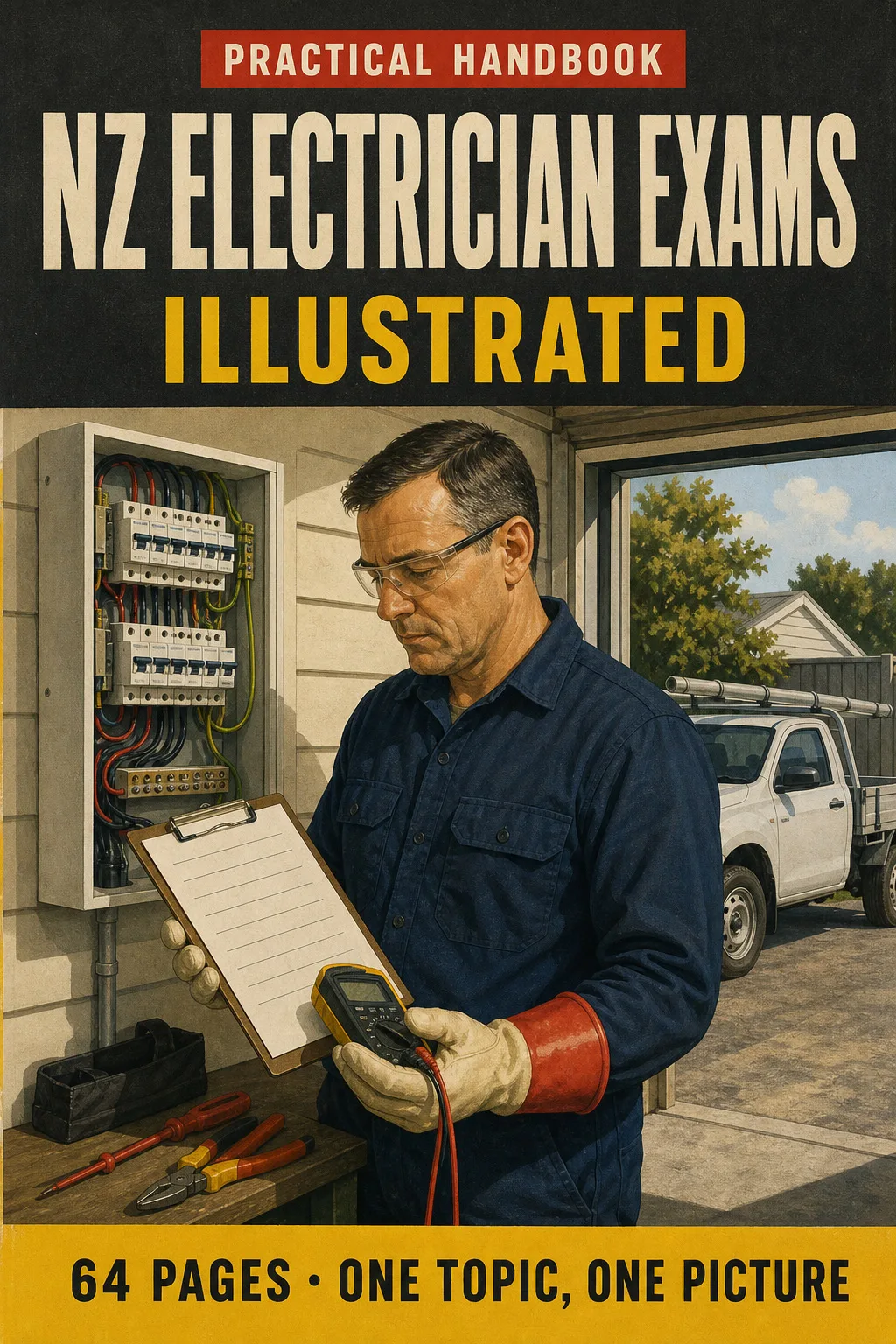
NZ Electrician Registration in Drawings: the Rules, the Calculations and the Tests, Always in the Same Order One Topic on Every Page

For the NZ registration exams (theory and regulations) and the practical assessment, whether you're an apprentice or trained overseas: the regulations, MEN earthing, RCDs, breakers, cable sizing, voltage drop, safe isolation and the test sequence. One page per topic: the drawing first, then what to remember. 64 illustrated pages.

START STUDYING THIS WAY

🔒 Secure checkout · PDF by email · 30-day guarantee

Every topic, its own pageEach rule drawn, with the explanation right beside it
64 illustrated pages8 parts, from the map of the rules to the final exam checklist
Up-to-date sourcesElectricity (Safety) Regulations 2010, AS/NZS 3000 and EWRB requirements
PDF by emailFormat

Look Inside the Book

Every page has one big drawing and a box with the numbers and steps you need to know:

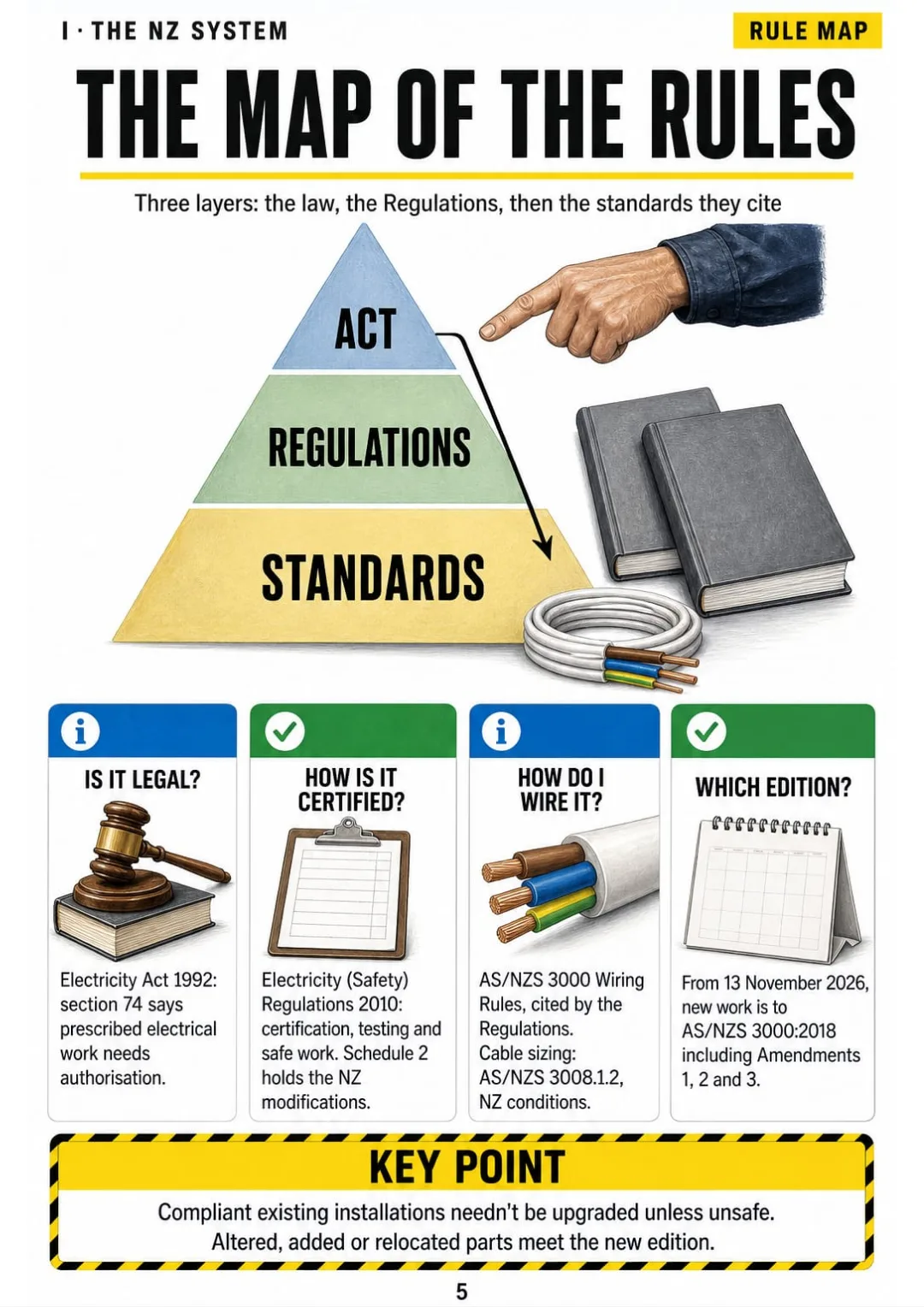
Act 1992 → Regulations 2010 → AS/NZS 3000:2018 for all new work from 13 November 2026
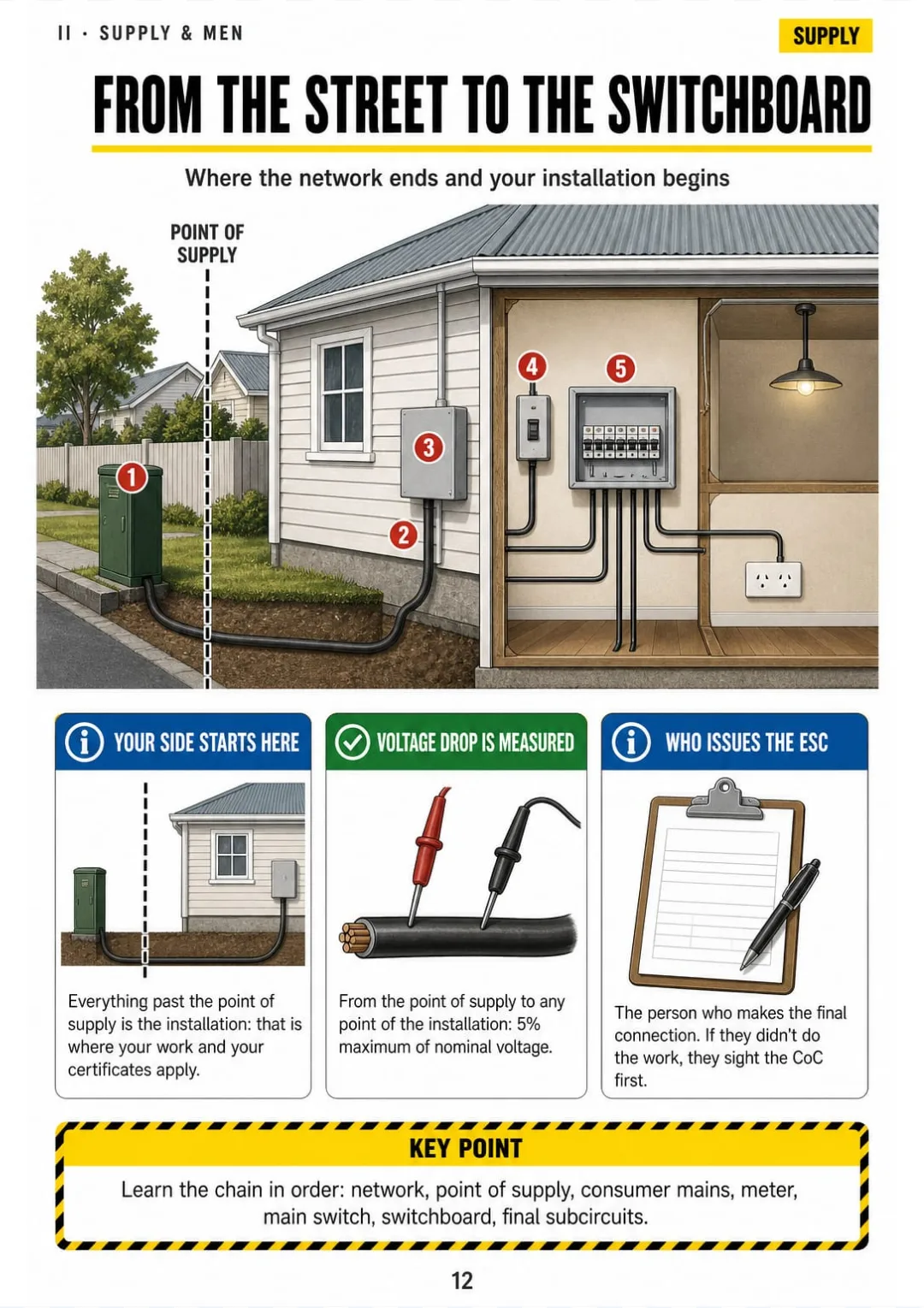
Network → point of supply → consumer mains → meter → main switch → switchboard → final subcircuits
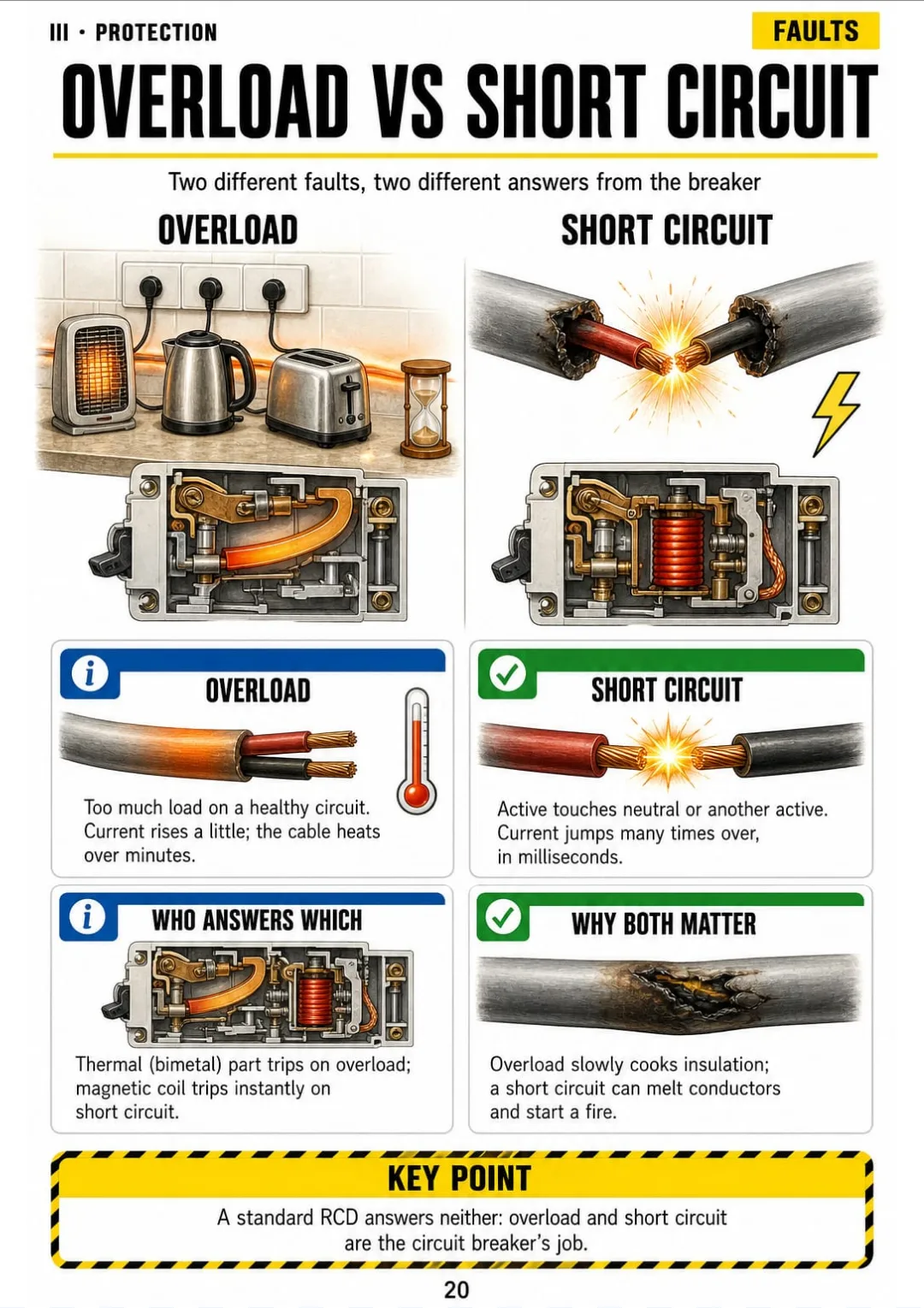
Overload = bimetal, slow. Short circuit = magnetic coil, instant.
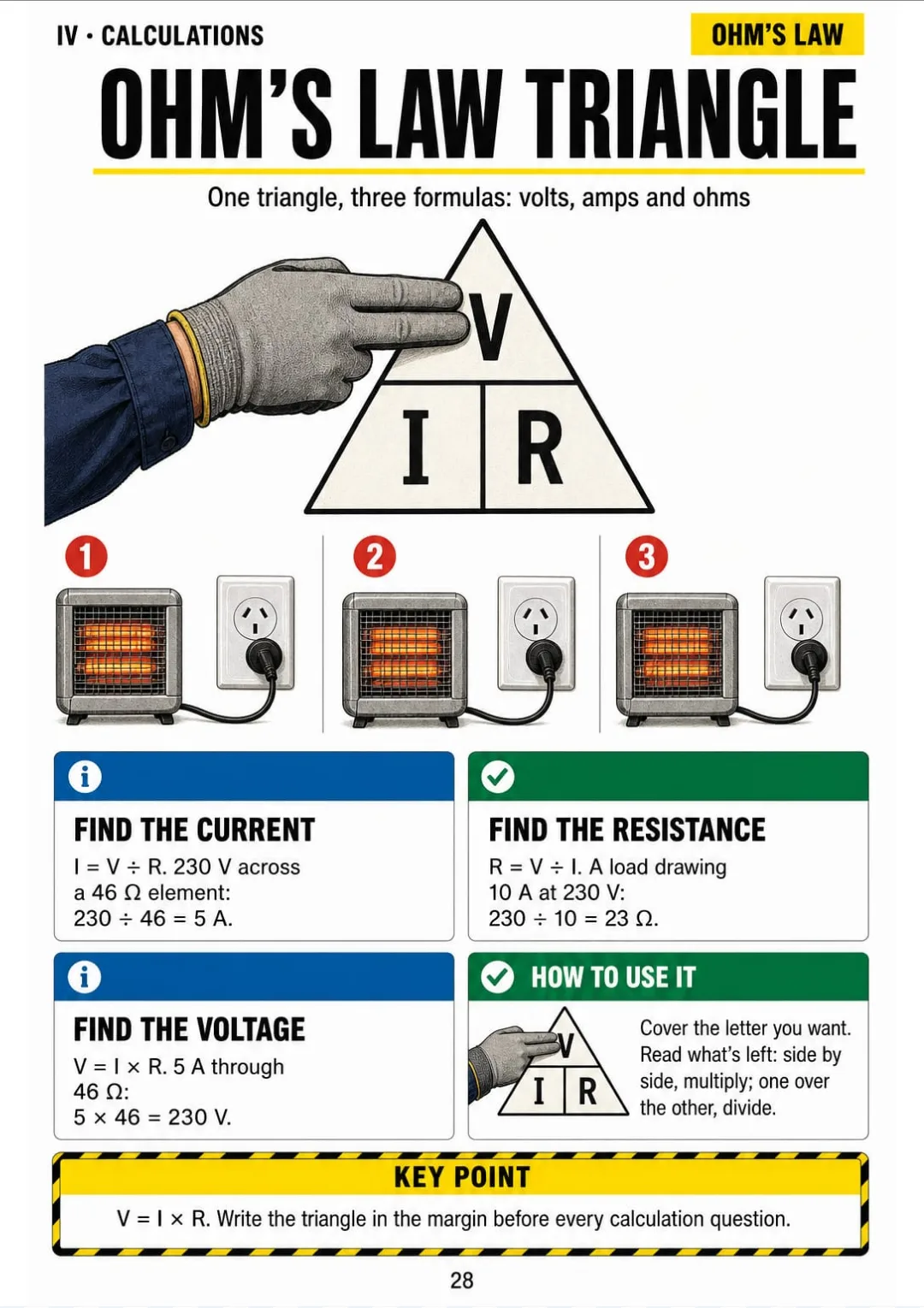
V = I × R: 230 V across 46 Ω gives 5 A
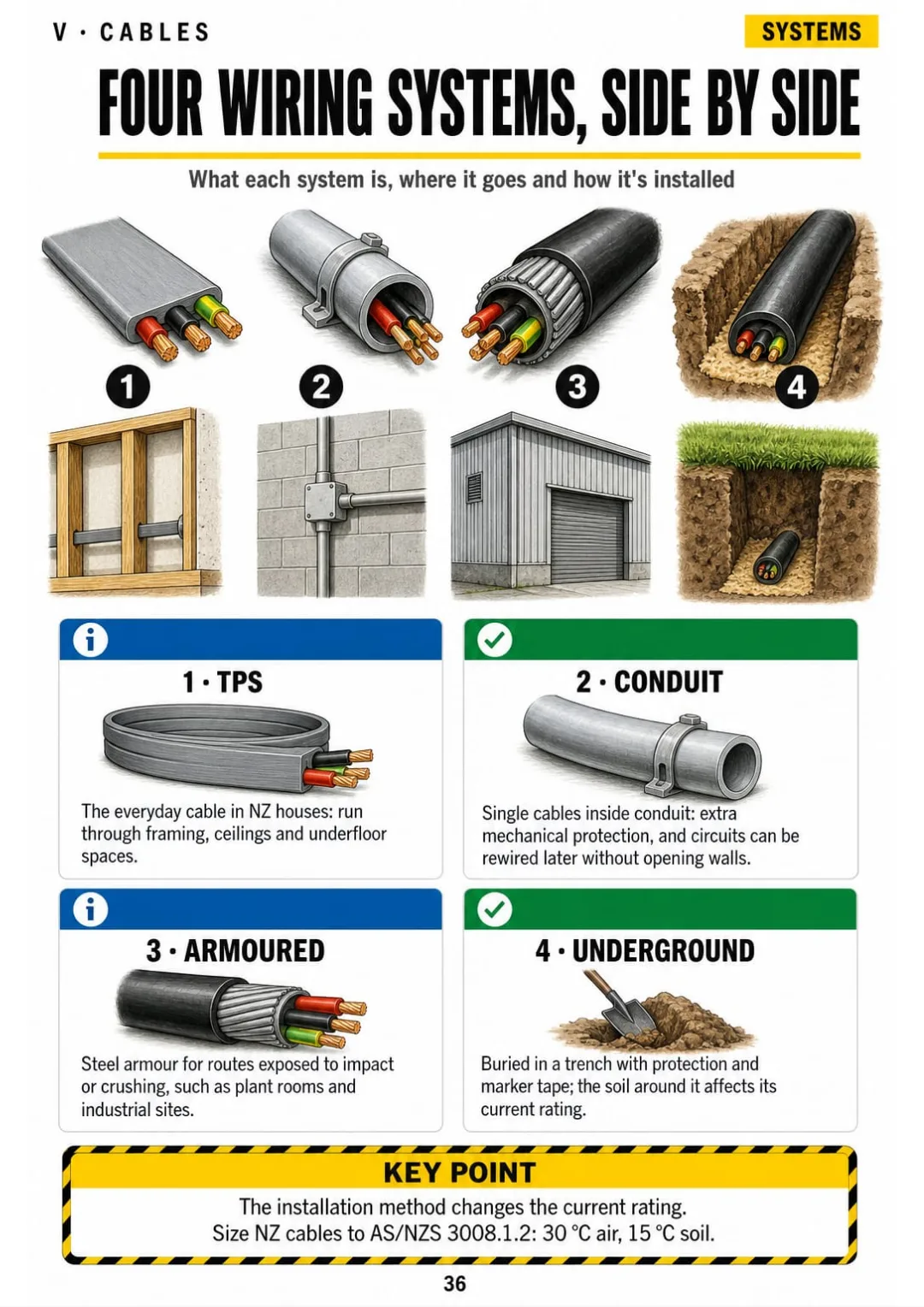
Four wiring systems drawn side by side, each with where it's used and how it's installed
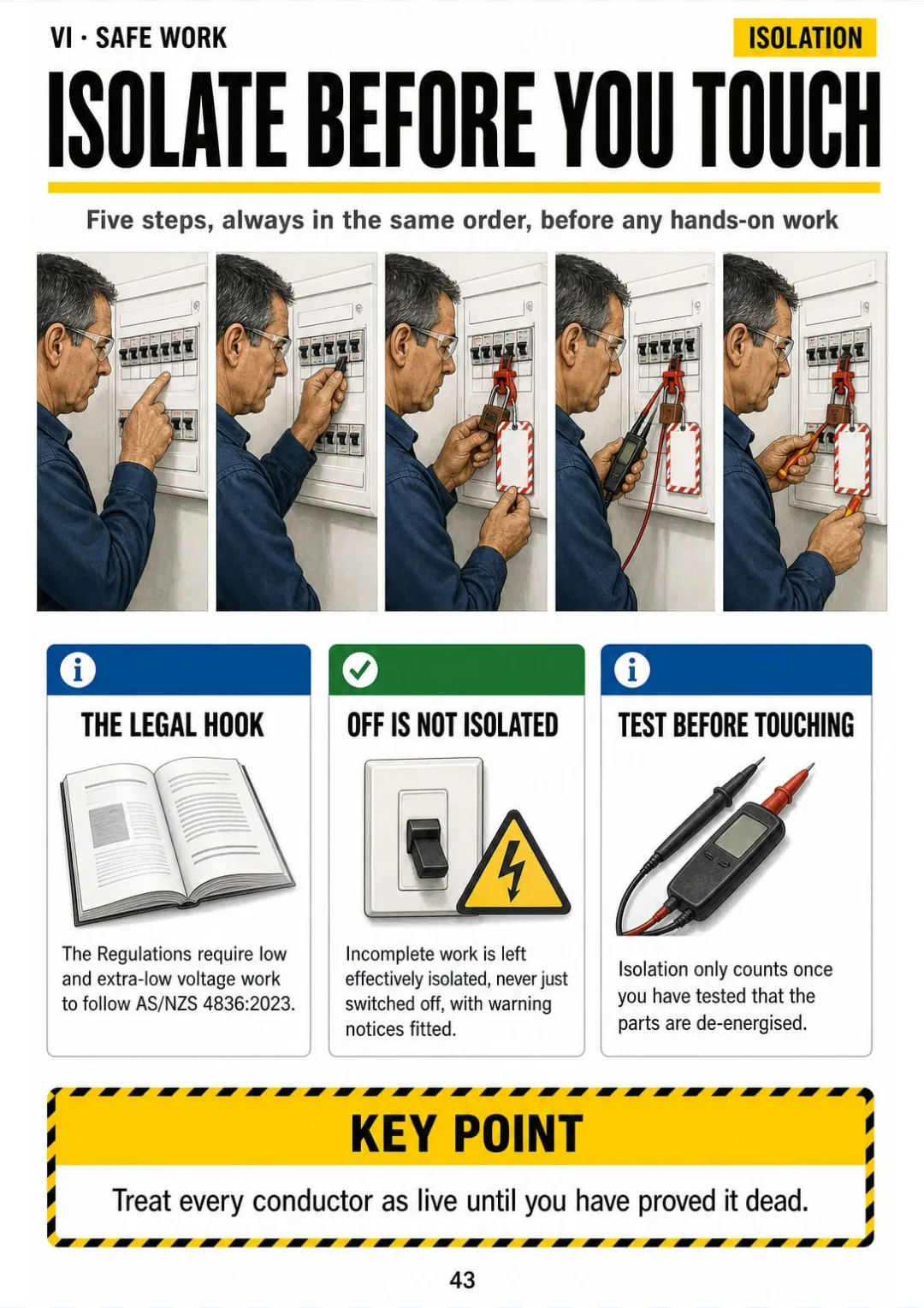
Identify → isolate → secure → test → work, as set out under ESR reg 100 and AS/NZS 4836:2023.
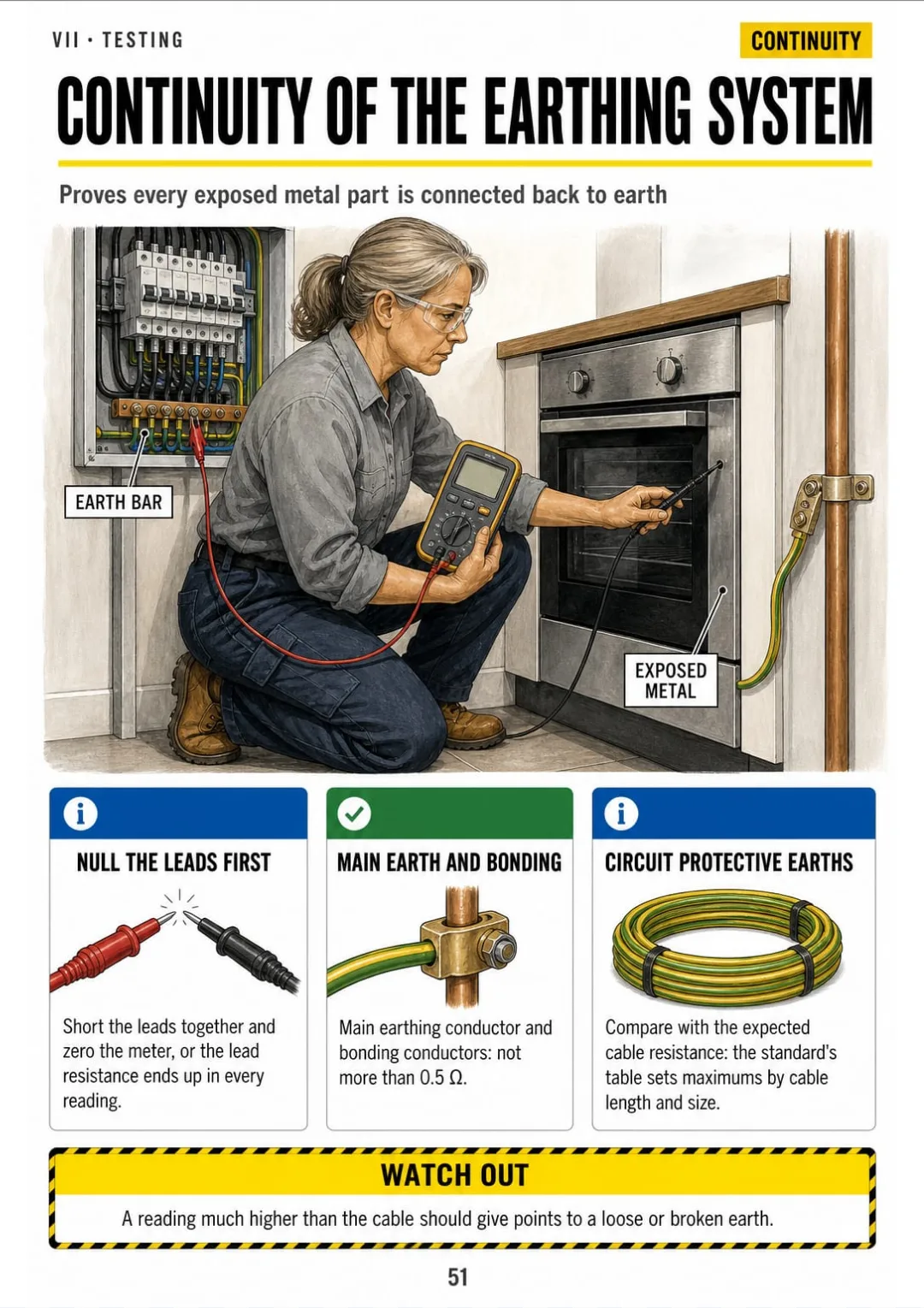
Earth continuity: leads nulled, main earth and bonding ≤ 0.5 Ω, circuits within the table.
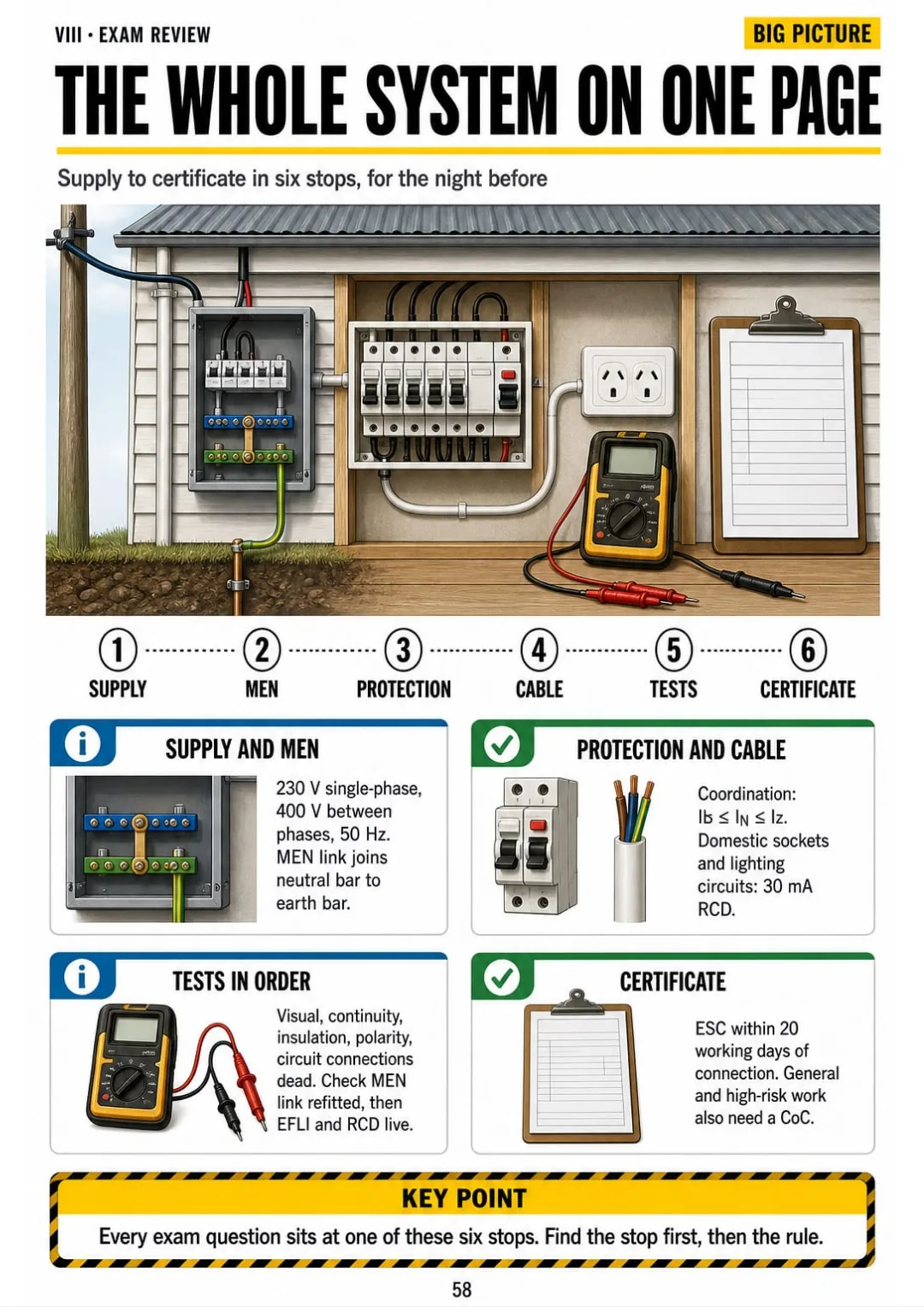
Six stops from street to certificate: 230 V, MEN link, IB ≤ IN ≤ IZ, tests in order, ESC in 20 working days.

Swipe to see more →

These are real pages from the book. The table of contents is the full one: 8 parts and 60 topics.

The Problem Isn't You. It's How It Was Explained.

You're at the main switchboard and the question sounds simple: where do neutral and earth meet, and why only there?

You've wired boards for years, just not the NZ way. The manual explains the MEN system in paragraphs: neutral, earth bar, electrode, sub-boards, all in one block. By the next morning, what goes where has blurred.

Overload = bimetal, slow. Short circuit = magnetic coil, instant.

In the book, the MEN system is drawn from the street to the sub-board: one link at the main switchboard, the electrode below it, and neutral and earth kept separate at every board after that.

The same goes for breakers, RCDs, voltage drop, safe isolation and the test sequence: each one has its own page.

You see why the link sits where it does, and you can explain it to the assessor without going back to the manual.

COMPARE FOR YOURSELF

Same Topic, Two Ways to Study It

THIS
  • The manual: line after line
  • The supply arrangement explained only in words
  • You walk into the exam unsure
The electricity supply to an installation is delivered from the distribution network to the point of supply, beyond which the consumer mains, being the conductors between the point of supply and the main switchboard, become the responsibility of the installation owner. Metering equipment shall be installed in accordance with the arrangements of the network operator and the retailer, and the main switch shall be located on the main switchboard so as to permit isolation of the whole installation, from which the final subcircuits are then distributed.
FOR THIS
  • Street to switchboard in one drawing
  • Each stop in a numbered box
  • You see it and it makes sense
Network → point of supply → consumer mains → meter → main switch → switchboard → final subcircuits
CONTENTS

Take a Look at the 8 Parts and 60 Topics

The NZ system, supply and MEN earthing, protection, calculations, cables and installation, safe isolation, testing and certification, and the exam review: 64 pages, all illustrated

IThe NZ system: who can do what · pp. 5-11
  1. The map of the rules: Act, Regulations, Standards
  2. Registration vs practising licence
  3. Prescribed electrical work in one picture
  4. Working under supervision
  5. Low, general and high risk work
  6. Coming from overseas: what changes in NZ
  7. The three hurdles: theory, regulations, practical
IISupply and MEN earthing · pp. 12-19
  1. From the street to the switchboard
  2. 230 V, 400 V, 50 Hz: the NZ numbers
  3. The MEN system in one drawing
  4. Why the MEN link exists
  5. Earth electrode, main earthing conductor, earth bar
  6. Equipotential bonding
  7. Lost neutral: the fault you must recognise
  8. Colours of conductors in NZ
IIIProtection · pp. 20-27
  1. Overload vs short circuit
  2. Circuit breakers and their curves
  3. The coordination rule: load, device, cable
  4. RCDs: how they detect leakage
  5. Where 30 mA RCDs are required
  6. RCD types and RCBOs
  7. Discrimination between devices
  8. Main switches and isolation points
IVCalculations in numbered steps · pp. 28-35
  1. Ohm's law triangle
  2. Power: watts, current and three-phase
  3. Series and parallel resistances
  4. Voltage drop: the 5% limit
  5. Voltage drop step by step
  6. Choosing cable size in 4 steps
  7. Derating: grouping, heat and insulation
  8. Earth fault loop impedance
VCables and installation · pp. 36-42
  1. Wiring systems at a glance
  2. Mechanical protection and safe zones
  3. Underground cables
  4. Socket outlets and switches
  5. Bathrooms and wet areas: zones
  6. Switchboard layout and labelling
  7. Motors and fixed appliances
VISafe isolation and working safely · pp. 43-48
  1. Isolate before you touch
  2. Prove, test, prove
  3. Lock out and tag
  4. Live work: when it is allowed
  5. Electric shock: what happens in the body
  6. First response to an electrical accident
VIITesting and certification · pp. 49-57
  1. The test sequence, always in the same order
  2. Visual inspection checklist
  3. Continuity of the earthing system
  4. Insulation resistance
  5. Polarity and correct connections
  6. Earth fault loop impedance test
  7. RCD testing
  8. Certificates and records
  9. Filling in a test record
VIIIExam and practical review · pp. 58-64
  1. The whole system on one page
  2. Numbers to have at hand
  3. How to read a regulations question
  4. How to solve a calculation question
  5. Explaining your reasoning to the assessor
  6. Most frequent mistakes in testing
  7. Final checklist before exam day

One Page, One Topic, All Clear

Think of it this way:

The night before the practical assessment, you go over how you'll talk the assessor through the tests on the board you've wired.

In the book, you open the test sequence page and see eight boxes in a row: visual, continuity, insulation, polarity, circuit connections, MEN link check, loop impedance, RCD.

Four wiring systems drawn side by side, each with where it's used and how it's installed

Same with the MEN system, the coordination rule, voltage drop, bathroom zones and safe isolation: each one on its own page.

NZ Electrician Exams Illustrated is 8 parts and 60 topics, all drawn, ending with a full exam and practical review.

What you see drawn, you don't have to memorize.

What's Inside NZ Electrician Exams Illustrated:

Ipp. 5-11

The NZ system: who can do what

The map of the rules, registration vs practising licence, prescribed electrical work, supervision, risk levels and what changes when you come from overseas.

IIpp. 12-19

Supply and MEN earthing

Street to switchboard, the NZ voltages, the MEN system and why the link exists, electrode and earth bar, bonding, lost neutral and conductor colours.

IIIpp. 20-27

Protection

Overload vs short circuit, breaker curves, the coordination rule, RCDs and where 30 mA is required, RCBOs, discrimination and isolation points.

IVpp. 28-35

Calculations in numbered steps

Ohm's law, power and three-phase, series and parallel, voltage drop and the 5% limit, cable sizing in 4 steps, derating and loop impedance: every calculation set out in the same steps, so you always know what comes next.

Vpp. 36-42

Cables and installation

Wiring systems, mechanical protection and safe zones, underground cables, sockets and switches, bathroom zones, switchboard layout, motors.

VIpp. 43-48

Safe isolation and working safely

Isolate before you touch, prove-test-prove, lock out and tag, when live work is allowed, electric shock and first response.

VIIpp. 49-57

Testing and certification

The test sequence in order, visual inspection, continuity, insulation resistance, polarity, loop impedance, RCD testing, certificates and test records.

VIIIpp. 58-64

Exam and practical review

The whole system on one page, numbers to have at hand, how to read regulations and calculation questions, explaining your reasoning, final checklist.

At the end of the book: The whole system on one page, the numbers to have at hand and a final checklist before exam day.
Plus: 2 Free Books

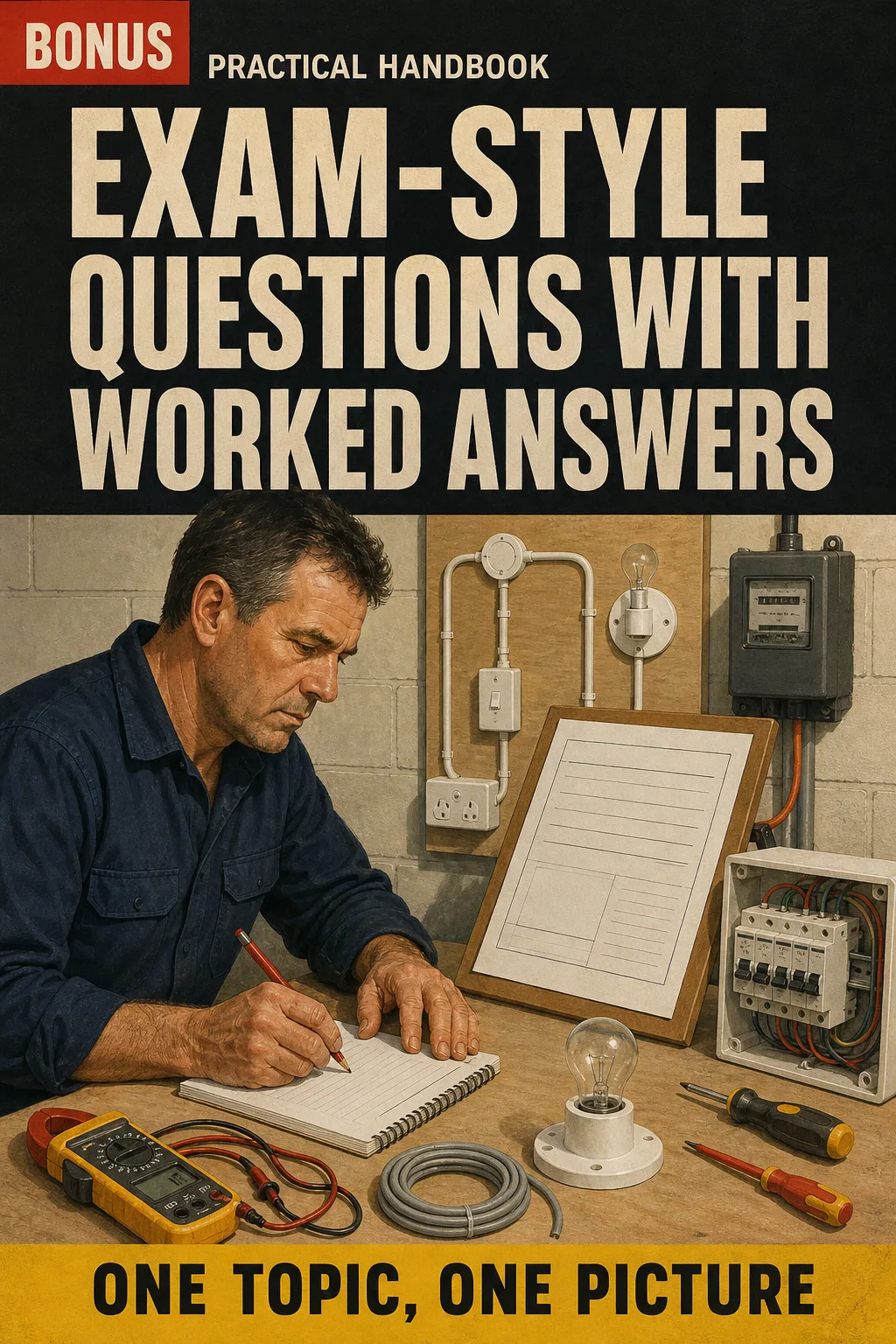
Exam-Style Questions with Worked Answers

BONUS 1: «Exam-Style Questions with Worked Answers»

Value on its own: US$ 17.90

Practise on regulations, earthing, protection and calculation questions, and see the reasoning behind every answer, not just the letter.

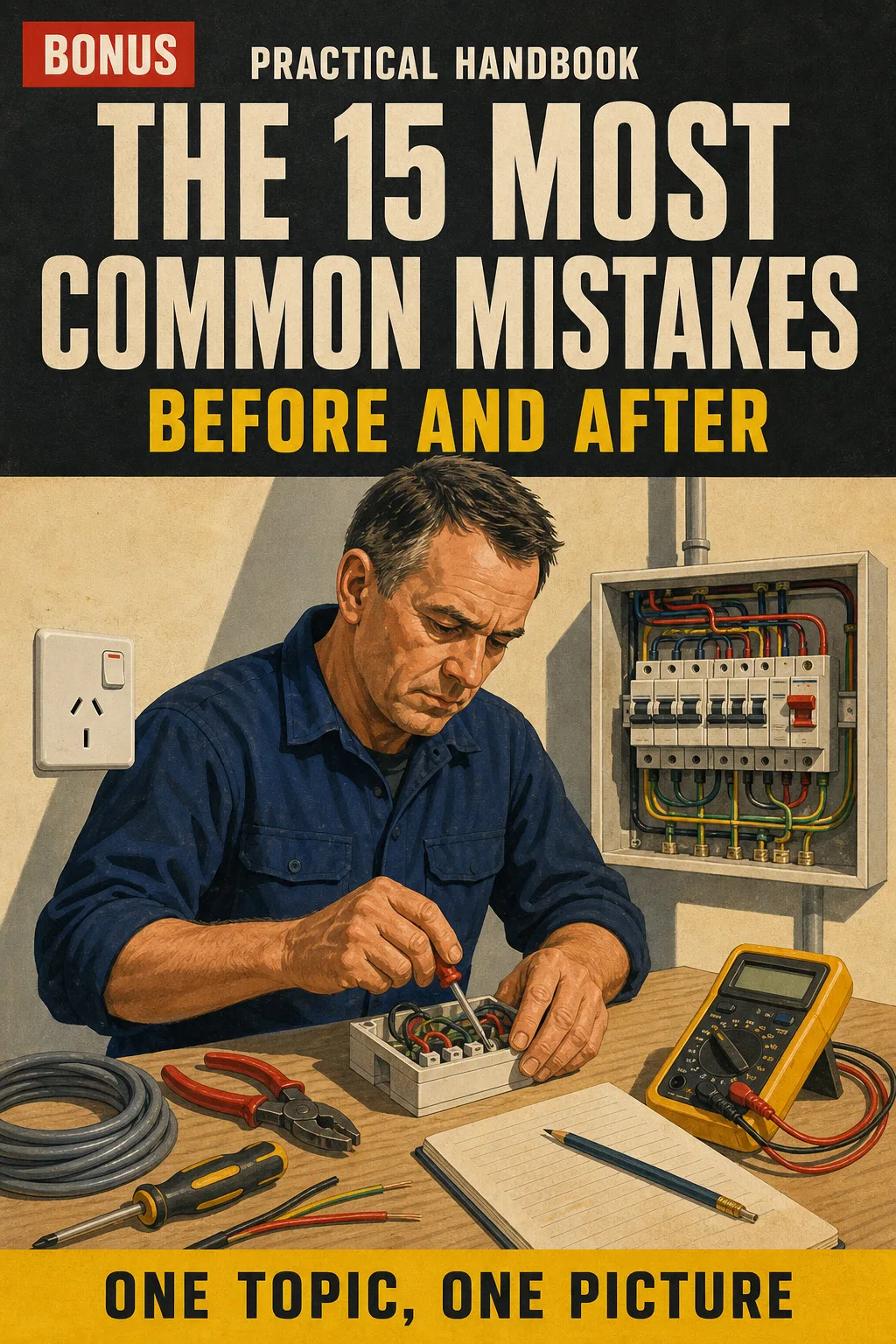
The 15 Most Common Mistakes: Before and After

BONUS 2: «The 15 Most Common Mistakes: Before and After»

Value on its own: US$ 14.90

See the errors candidates and installers make most often, drawn wrong and then right, so you catch them before the exam or the assessor does.

NZ Electrician Exams Illustrated with 2 Free Books

  • NZ Electrician Exams Illustrated: 64 illustrated pagesUS$ 63
  • BONUS 1: Exam-Style Questions with Worked AnswersUS$ 17.90
  • BONUS 2: The 15 Most Common Mistakes: Before and AfterUS$ 14.90
  • High-resolution PDF to printIncluded
Total value US$ 95.80
YOUR PRICE:
US$ 27
You save US$ 68.80
YES, I WANT NZ ELECTRICIAN EXAMS ILLUSTRATED FOR US$ 27

📄 This is a digital PDF book sent to your email: nothing is printed or shipped.

Secure purchaseEncrypted payment30-day guarantee

PDF by email: We email you NZ Electrician Exams Illustrated as a PDF, together with the two free books. It's a single payment: no installments, no extra charges.

Who This Book Is For

You're an apprentice studying for registration

You're an apprentice studying for registration

Each topic of your course on its own page, drawn, so you can revise in a break on site and the order sticks.

Your exams are close

Your exams are close

The numbers, the calculation steps and the test sequence on one page each, to go over the night before without opening the Wiring Rules.

You trained overseas and already work

You trained overseas and already work

Every topic marks what changes in NZ, from MEN earthing to prescribed electrical work, so you know what to relearn and what you already do right.

Everything You Get Today

US$ 95.80US$ 27
YES, I WANT NZ ELECTRICIAN EXAMS ILLUSTRATED FOR US$ 27

📄 This is a digital PDF book sent to your email: nothing is printed or shipped.

30DAYS
GUARANTEE

30-Day Guarantee

Try NZ Electrician Exams Illustrated for 30 days, bonus books included.

We refund everything if the file won't open, if the book isn't what you see here, if you were charged twice or if the email doesn't arrive. Just email us.

You pay once. No subscriptions.

Frequently Asked Questions

Is it for me if I trained overseas and I'm registering in NZ?

Yes. It's written for New Zealand: NZ regulations, AS/NZS 3000 and metric units, and each topic marks what changes compared with other countries. It covers what's asked in the theory exam, the regulations exam and the practical assessment. It works for apprentices too, and it goes straight to what's asked, not the basics.

Where does the content come from?

From the Electricity Act 1992, the Electricity (Safety) Regulations 2010, AS/NZS 3000, AS/NZS 3008.1.2 and the requirements published by the EWRB and WorkSafe NZ. Standards change: check numbers and values against the current official version.

Is it official material?

No. It's an independent study book. It isn't published, approved or endorsed by the EWRB, WorkSafe NZ or Standards New Zealand.

Does it replace my course or training?

No. It's for revising alongside your training and supervised work. It doesn't qualify you to do prescribed electrical work; always check the standard and the requirements against the official source.

Are the practice questions the real exam questions?

No. They're written for this book, in exam style, to practise the reasoning. They aren't official questions from any exam.

How does it arrive?

The book and the 2 bonus books arrive as PDFs by email, to the address you enter at checkout.

Do I have to pay every month?

No. It's a one-off payment.

Can I have it on paper?

Yes. It's a PDF ready to print, at home or at a print shop.

How does the refund work?

You have 30 days. We refund everything if the file won't open, if the book isn't what you see on this page, if you were charged twice or if the email doesn't arrive: just email us.

Before You Close This Page

No more rereading with nothing staying.

The MEN system: you see it drawn, and that's it.

You walk into the exam knowing where everything is.

Drawings make studying faster.

The book is right below.

One-time payment: US$ 27 · Guarantee: 30 days · PDF by email

YES, I WANT NZ ELECTRICIAN EXAMS ILLUSTRATED FOR US$ 27

📄 This is a digital PDF book sent to your email: nothing is printed or shipped.